New Way to Study Electron Transfer Reactions Leads to Hot Paper, Journal Cover
Researchers at Pacific Northwest National Laboratory report a new path to study electron transfer dynamics by coupling single-molecule microscopy with an electrochemical instrument—a potentiostat. This enables them to better understand electron transfer reactions, which in turn could lead to understanding reactions common to biofuel production and solar energy conversion... More
Melding Experiment and Theory Sheds Light on Molecular Recognition
For the first time, scientists have determined in the laboratory how much energy is needed to release a large complex molecule from its target without solvent present. The team from Pacific Northwest National Laboratory combined experimental and computational work to get this previously unknown answer... More
Hot Topic: Hydrogen Storage
Powering vehicles with hydrogen instead of gasoline could reduce our reliance on dwindling fossil fuels. For this to happen, manufacturers need a material that can safely store and release hydrogen to power a fuel cell. So, scientists at Pacific Northwest National Laboratory designed a new method of making such a material, ammonia borane. Energy & Environmental Science named the resulting article a hot paper in September 2008... More
An Electron's Exit
Like a teen moving out on their own, an electron can go in a lot of different directions when it leaves its home molecule. Now, researchers can see the path the exiting electron takes thanks to scientists at Pacific Northwest National Laboratory and Washington State University... More
Science Going "Well" at Uranium Monitoring Site
On September 17, Pacific Northwest National Laboratory hosted reporters from the Tri-City Herald, KNDU-TV, KVEW-TV, and Northwest Public Radio at the site of an innovative monitoring well system that will thoroughly characterize the uranium-contaminated subsurface within Hanford's 300 Area... More
Using Mother Nature to Reduce Greenhouse Gases
New research suggests that adopting low-cost land management practices that naturally sequester carbon dioxide could contribute up to 20% of the carbon mitigation needed worldwide in the first half of this century. For the first time, scientists included terrestrial sequestration options in computer simulations of the cost and technology options necessary to stabilize greenhouse gas concentrations in the atmosphere by 2100. . . More
Getting the Dirt on Nitrogen in Agroecosystems
Crop soils that are fed with biologically based nitrogen do a better job than synthetic fertilizers at retaining nitrogen, so less escapes into the air and water. . . More
Dedicated Optical Networks Transforming Computational Science and Collaboration
Collaborative visualization of large-scale datasets across geographically distributed sites is becoming increasingly important for many science domains ranging from biology to the subsurface... More
Review Article Chronicles Research on Versatile Bacterium
A microbe that mediates carbon and metal cycling in stratified marine and freshwater environments and serves as a model microbe for systems biology research is highlighted in a review article in Nature Reviews Microbiology... More
New Data Analysis Tools Advance Protein Research
From developing viable bioenergy to detecting disease, proteins are crucial structural and functional elements to all biological functions. Proteomics experts from Pacific Northwest National Laboratory and two universities have collaborated to develop and deploy data analysis tools to further the field of protein research. Two of these tools are now available free of charge through publicly available websites... More
PNNL Research Shedding Light on Complex Reactions at Interfaces
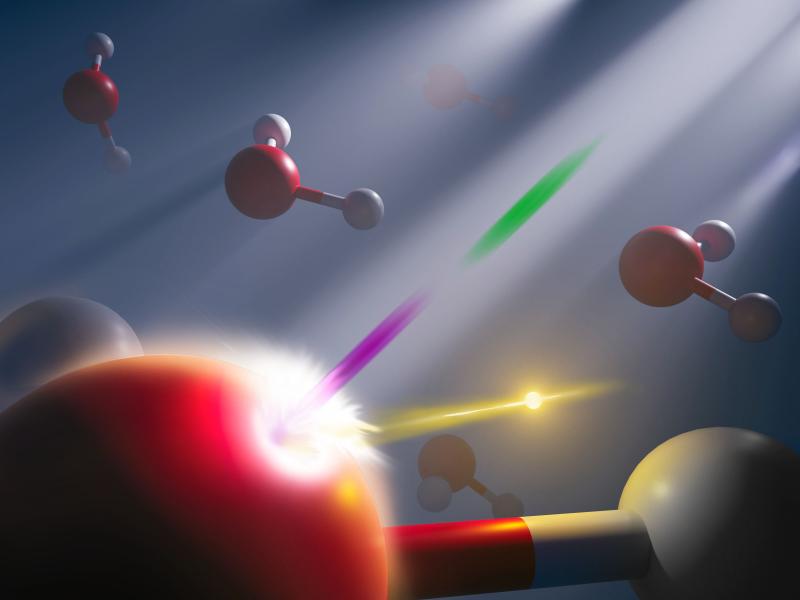
Using computational resources from INCITE and Pacific Northwest National Laboratory's NWICE, researchers are shedding light on complex chemical reactions at interfaces. The PNNL computational approach sought to resolve a mystery that had eluded experimentalists - where are hydroxide ions located on molecules as they move from the liquid to the gaseous state?... More